


Doctor examining little girl.

Pfeifer Syndrome

A condition affecting craniofacial development, with care focused on growth and long-term outcomes

What Is A Pfeiffer Syndrome
Understanding Pfeiffer Syndrome

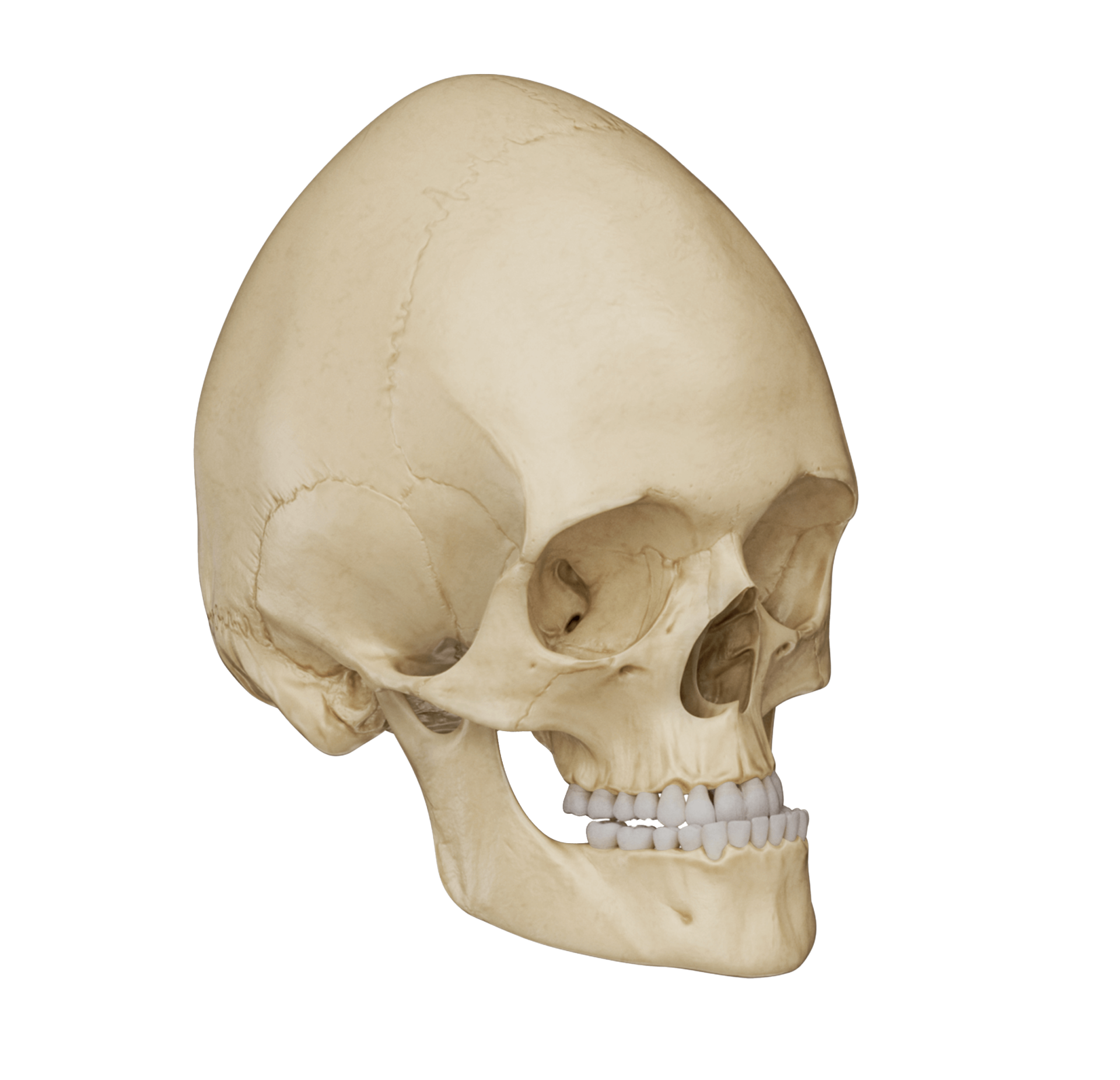
Pfeiffer Syndrome is a rare genetic condition characterized by the premature fusion of certain skull bones during early fetal development, a process known as craniosynostosis. This early fusion affects skull shape and can influence brain growth, facial development, and airway structure.

Children with Pfeiffer Syndrome often present with distinctive craniofacial features and may experience functional challenges related to breathing, vision, and hearing. Limb differences are also common and may include broad, angled thumbs and great toes, as well as shortened fingers or toes. Because skull and facial growth are closely linked, the condition requires coordinated, staged care rather than a single corrective intervention.

Illustration of craniofacial features of Pfeiffer syndrome.
Pfeifer Syndrome

Defining Characteristics

Pfeiffer Syndrome can affect multiple aspects of development, including the skull, face, airway, and the hands and feet. Restricted skull growth may influence brain development, while midface differences can impact breathing and facial structure over time. The specific combination and severity of these findings vary, guiding evaluation and shaping a coordinated approach to care.

Craniosynostosis

Premature fusion of skull sutures can affect head shape and limit normal brain growth.

Midface Underdevelopment

Shallow midface structure may contribute to breathing difficulties and eye exposure.

Broad Thumbs & Toes

Enlarged or deviated thumbs and great toes are a characteristic feature.

Airway & Vision Concerns

Facial structure differences may affect breathing, eye protection, and visual development.

Coordinated Pediatric Specialty Care

Children with Pfeiffer syndrome need coordinated care across a dedicated team, with each step aligned to support skull and facial growth, airway function, and overall development, including the hands and feet. Care is carefully timed—from early evaluation through staged treatment and long-term follow-up—to ensure safe, consistent progress as your child grows.

Multidisciplinary Care

Children with Pfeiffer Syndrome benefit from a coordinated team approach including specialists in:

Craniofacial Surgery
Pediatric Neurosurgery
Oral & Maxillofacial Surgery
ENT / Otolaryngology
Hand Surgery
Ophthalmology
Orthodontics
Speech Therapy
Pediatrics

Treatment & Care Pathway

Doctor discussing health concerns with a mother and child in a clinic.

Cranial Fusion Management

Treatment focuses on managing prematurely fused skull sutures to support normal brain growth, reduce pressure concerns, and improve skull development throughout childhood.

Child with blonde hair playing with toy cars at a wooden desk.

Midface, Airway & Ocular Care

Care focuses on breathing, eye protection, and midface development to address functional concerns commonly associated with Pfeiffer syndrome.

Girl with braided hair wearing pink hoodie facing water.

Planning for Craniofacial Surgery

Long term evaluation helps determine if and when midface advancement may improve airway support, eye protection, and facial balance.

Doctor consulting with patient about Pfeiffer Syndrome in a clinical setting.

Planning for Corrective Jaw & Nasal Surgery

Growth monitoring helps determine whether corrective jaw and nasal surgery may be needed to improve bite function, breathing, and facial harmony.

Surgical Treatment Options
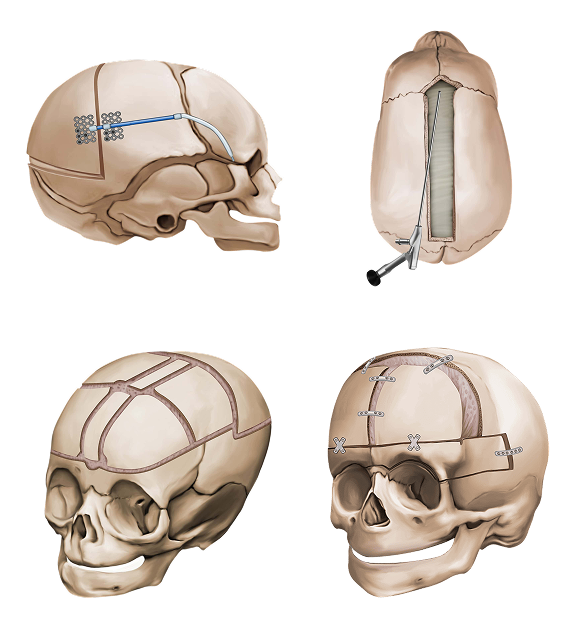
Illustration of cranial vault reshaping techniques for craniosynostosis in children.

Cranial Vault Procedures

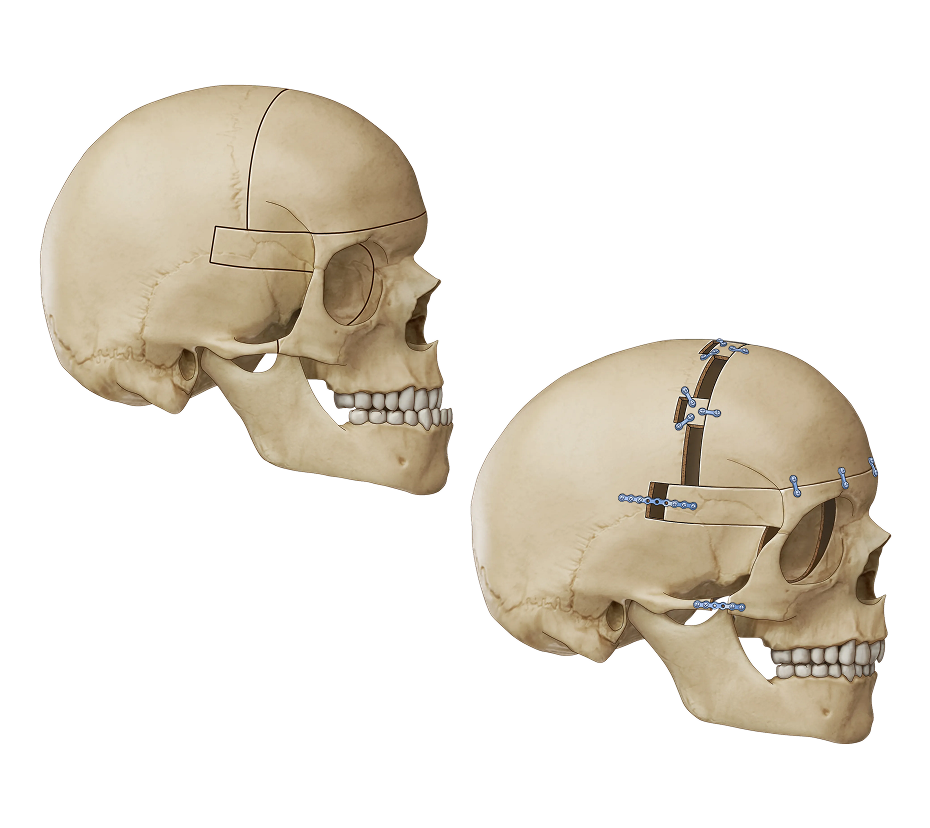
Cranial Vault procedures including endoscopic techniques, cranial vault remodeling, fronto-orbital advancement (FOA), and cranial distraction are typically performed in infancy in Pfeiffer syndrome to release fused sutures, allow for normal brain growth, and improve skull shape. The specific approach depends on age and severity, with minimally invasive techniques used earlier and more comprehensive remodeling or distraction used in more complex cases.

Illustration of Le Fort III surgery repositioning the midface.

Lefort III Osteotomy

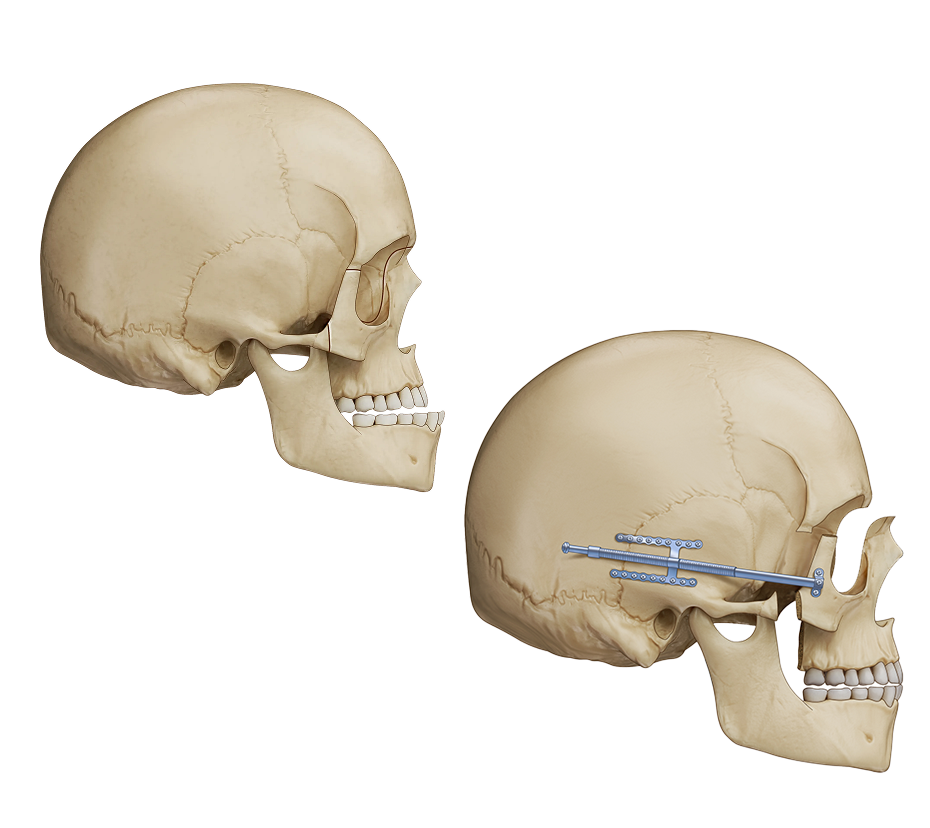
In some children with Pfeiffer syndrome, Le Fort III osteotomy may be recommended to advance the midface and improve airway function, eye protection, and facial balance. It is most often considered when significant midface underdevelopment affects breathing or ocular support, with timing individualized based on growth and clinical needs.

Monobloc Advancement Illustration

Monobloc Advancement

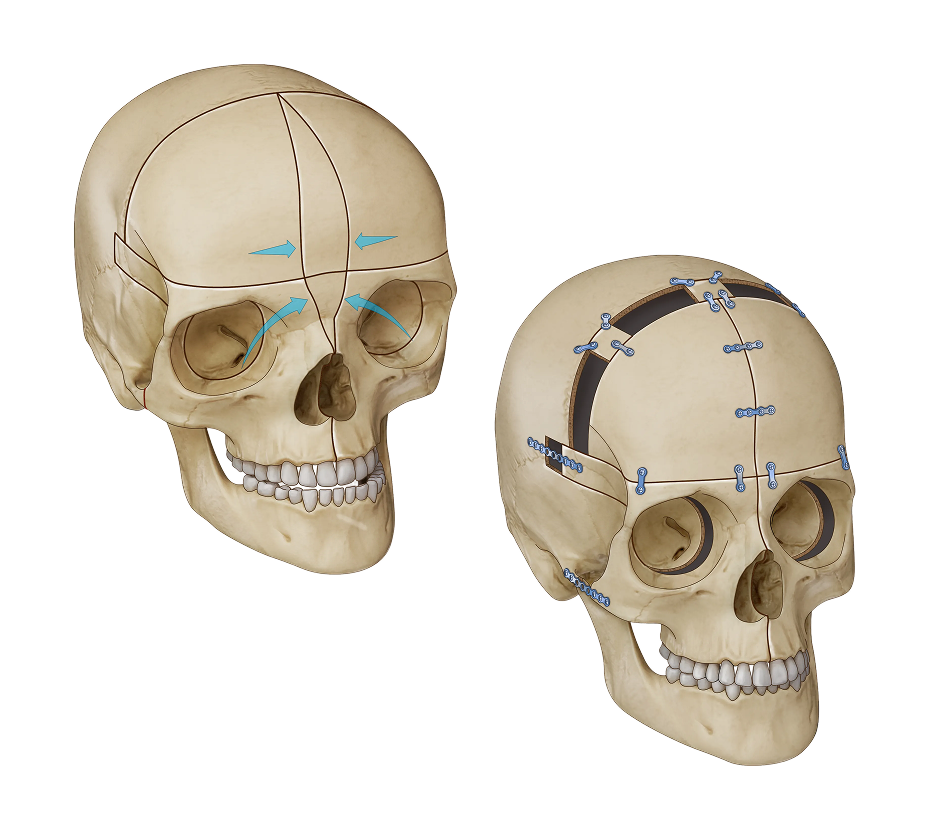
Monobloc advancement is used in more severe cases, usually in early childhood, to move the forehead and midface forward together. This approach increases intracranial space, improves eye protection, and addresses significant midface deficiency in a single coordinated procedure.

Monobloc Facial Bipartition Illustration

Monobloc Frontofacial Bipartition

Monobloc frontofacial bipartition is performed in early childhood in more complex cases with midface deficiency or increased spacing between the eyes. In addition to advancing the forehead and midface, this procedure reshapes and repositions the facial skeleton to improve eye position, facial symmetry, airway development, and overall craniofacial balance.

Pfeiffer Syndrome Subtypes

Historically, Pfeiffer syndrome has been classified into three subtypes based on the severity of craniofacial involvement and associated medical concerns. While these categories remain useful for describing the range of presentations, every child is unique, and treatment decisions are based on the individual’s specific anatomy, symptoms, and needs.

Type 1 Pfeiffer Syndrome

Type 1, often referred to as classic Pfeiffer syndrome, is generally the mildest form. Children typically have craniosynostosis, broad thumbs and great toes, and varying degrees of midface underdevelopment. Intelligence is usually normal, and many children achieve excellent outcomes with appropriate treatment and long term follow up.

Type 2 Pfeiffer Syndrome

Type 2 Pfeiffer syndrome is a more severe form characterized by significant craniosynostosis and more extensive craniofacial differences. Children may experience airway, eye protection, neurologic, and developmental challenges that require early and coordinated multidisciplinary care.

Type 3 Pfeiffer Syndrome

Type 3 Pfeiffer syndrome shares many features with Type 2 but without the characteristic cloverleaf skull deformity often seen in Type 2. Children typically require comprehensive management of craniofacial, airway, and developmental concerns throughout childhood.

Individualized Care for Every Child

Although the traditional subtypes remain useful for understanding the spectrum of Pfeiffer syndrome, treatment is guided by each child’s specific findings rather than the subtype alone. Care is individualized to address functional needs, support healthy development, and achieve the best possible long term outcome.

Treatment Timeline

Birth

Diagnosis, Genetics Consultation, and Specialist Evaluation

Treatment varies significantly by type; imaging and multidisciplinary planning.

Birth – 2 weeks

Emergency Cranial Decompression and VP Shunt (if indicated)

For severe intracranial pressure; Types 2 and 3.

Birth – Age 2

Airway Management (if indicated)

Tracheostomy may be required long-term in severe cases

Age 2–6 months

Endoscopic Surgery + Helmet Therapy (if endoscopic path)

Minimally invasive surgery followed by custom molding helmet.

Age 6–12 months

Craniosynostosis Repair and Frontal Orbital Advancement (if open path)

Surgical reshaping of skull and orbital rim to restore normal growth.

Age 1

Ophthalmology Monitoring Initiated

Ongoing management of proptosis and corneal exposure.

Ages 2–4

Speech Therapy Initiated (if indicated)

Early intervention for resonance and speech delays.

Ages 4–8

Elbow Fusion Management (if indicated)

Coordinated with appropriate specialist team.

Ages 6–10

Le Fort III, Monobloc, or Facial Bipartition

Midface advancement with or without distraction; approach based on severity.

Ages 10–12

Phase 1 Orthodontic Treatment (if indicated)

Appliances guide bite and jaw development.

Ages 14–16

Pre-Surgical Orthodontics and Planning (if indicated)

Virtual surgical planning and final orthodontic alignment.

Ages 16–18

Orthognathic Surgery (if indicated)

Definitive correction of bite and facial balance at skeletal maturity.

Young adult

Post-Surgical Orthodontics and Long-Term Follow-Up

Experience Matters

“We personally plan your care, perform your surgery, and guide your recovery. No residents, no fellows, no handoffs.

Choosing the right surgical team matters. You should feel informed, comfortable, and confident in every step of the process. At our practice, your care is provided by one of the most highly trained and experienced jaw surgery teams in the country.

When you come to our office, you meet directly with your surgeons. We are the ones who plan your treatment, perform your surgery, see you after surgery, and remain personally available to you throughout your recovery. Unlike larger institutions, your care is not delegated to residents, fellows, or doctors in training. Every critical aspect of your treatment is handled by your surgeons.


Founding Members of the American Society of Orthognathic Surgery

What Our Patients Are Saying
Handsome young man, blue shirt, short hair, smiling
★★★★★

Dr Lee and the team at Northeast Facial are incredible. I was very nervous about my procedure but Dr Lee walked me through it step by step, never once making me feel rushed. Silvanna at the front desk went above and beyond to help me schedule an appointment that worked for me. I would highly recommend NEFOSS!

Stephanie Brown

★★★★★

“I had double jaw surgery done with Dr. Jacob in June 2021. I am extremely happy with my results. No more jaw pain and chewing problems. I also feel much more confident with my new smile. The surgery was definitely well worth it, thanks to Dr. Jacob and his team!”

Amelia Chen

★★★★★

“I would definitely recommend Dr. Jacob and his team at NEFOSS! Dr. Jacob and the team of doctors are very knowledgeable about all aspects of the TMJ process. They are such a nice group of doctors! The office staff is also very helpful and very friendly.”

Tiffany Puopolo

Frequently Asked Questions

Our advanced jaw surgery procedures are designed to enhance your quality of life. With a focus on precision and patient comfort, we ensure optimal results tailored to your unique needs.

Choosing Your Care Team

How important is experience in treating Pfeiffer Syndrome?

Pfeiffer Syndrome often involves complex surgical, developmental, and functional concerns that require coordinated, specialized management. Outcomes depend heavily on a surgeon's training, clinical judgment, and familiarity with the nuances of this condition. Teams that regularly treat patients with Pfeiffer Syndrome are typically better equipped to manage both immediate surgical needs and long-term outcomes.

What is the difference between private practice and academic or hospital-based care?

In a private practice setting, care is often more streamlined and consistent, with the same surgeon closely involved in evaluation, treatment planning, surgery, and follow-up.

In academic or hospital-based settings, care may involve a larger team that can include residents or fellows participating under supervision. Both models can provide excellent care, but the structure and continuity of treatment may feel different. At our center, your care is delivered directly by your surgeon — not by residents, fellows, or surgeons in training.

Who will perform my surgery or procedure?

It is important to understand who is performing each part of your treatment. In some settings, the attending surgeon performs all critical portions of the procedure, while in others trainees may assist or participate under supervision. This should be discussed clearly in advance. At our center, your surgeon performs all critical portions of the procedure.

Will trainees be involved in my care?

Depending on the treatment setting, residents, fellows, or students may be involved in aspects of care. Patients and families should feel comfortable asking about their role and how care is supervised throughout treatment.

At our center, there are no residents or fellows involved in performing surgery.

Who will follow me after treatment or surgery?

Long-term follow-up is an important part of care for many conditions managed at our center. In some practices, post-treatment care may be shared among multiple providers, while in others the surgeon remains closely involved throughout recovery and monitoring. At our center, your surgeon personally follows you throughout recovery and long-term care.

How involved is the surgeon throughout the process?

Comprehensive care includes direct surgical involvement in evaluation, treatment planning, surgery, and long-term follow-up. Consistency throughout the process helps maintain continuity of care.

At our center, your surgeon is directly involved at every stage — from initial evaluation through treatment and follow-up.

Understanding Pfeiffer Syndrome

What is Pfeiffer Syndrome?

Pfeiffer Syndrome is a genetic condition involving premature fusion of the skull bones combined with broad, deviated thumbs and big toes, and sometimes webbing of the fingers or toes. It is classified into three types based on severity, with Types 2 and 3 involving more significant cranial and facial differences and often more complex medical needs.

What causes Pfeiffer Syndrome?

Pfeiffer Syndrome is caused by mutations in the FGFR1 or FGFR2 genes. Some cases are inherited from a parent, while others arise as completely new mutations with no prior family history. When there is no family history, the mutation occurred spontaneously and was not the result of anything either parent did or was exposed to during pregnancy.

How does Pfeiffer Syndrome affect the skull and face?

Premature skull fusion restricts normal skull expansion, which can create increased intracranial pressure and characteristic skull shape changes. The midface is often underdeveloped, and the eyes may appear prominent or wide-set. In more severe forms, the skull may have a towering or cloverleaf shape.

Does Pfeiffer Syndrome affect breathing?

Yes. Midface underdevelopment frequently causes airway narrowing and obstructive breathing, and some patients have significant airway concerns that require early management. Airway evaluation is an essential part of care, particularly in infancy.

Does it affect vision or neurological function?

Eye prominence and shallow orbits can place the eyes at risk and affect vision. Elevated intracranial pressure may affect neurological development if not addressed. Regular monitoring by neurosurgery, ophthalmology, and the craniofacial team is important throughout treatment.

Surgical & Treatment Considerations

What surgeries are typically involved?

Surgical management is staged and may include early cranial vault surgery to relieve intracranial pressure and improve skull shape, airway management procedures, midface advancement to improve the facial profile and airway, and jaw surgery to correct the bite in later years.

How does treatment differ across Pfeiffer Syndrome types?

Type 1 Pfeiffer Syndrome is generally the mildest and often has outcomes similar to other craniosynostosis syndromes. Types 2 and 3 are more severe and may require more complex or urgent surgical intervention, particularly in managing the airway and intracranial pressure in early infancy.

When is midface or jaw surgery performed?

Midface and jaw surgeries are typically staged, with midface advancement often performed during childhood and orthognathic jaw surgery considered after facial growth is complete in late adolescence or early adulthood.

Long-Term Monitoring & Growth

What long-term follow-up is needed?

Lifelong monitoring is important and includes assessment of intracranial pressure, facial growth, airway function, vision, speech, hearing, dental development, and bite alignment. Treatment is adapted as the patient grows and individual needs evolve.

Can individuals with Pfeiffer Syndrome live full lives?

Yes, particularly for those with milder forms. For all types, outcomes are strongly influenced by the quality and timing of coordinated surgical care and the management of airway, neurological, and developmental concerns early in life.

Traveling & Out-Of-Town Patients

Do families travel to your center for treatment?

Yes. We regularly care for families traveling from outside the region for specialized craniofacial care.

How long do families typically need to stay near your center?

The local stay depends significantly on the type of Pfeiffer Syndrome and the specific procedure performed. For cranial vault procedures, particularly in infants with more severe presentations, families should plan for approximately two to three weeks locally — this involves genuine ongoing monitoring of intracranial pressure, airway, and healing before travel is safe. For older patients undergoing midface advancement or jaw surgery, patients are typically discharged within two to three days and recovering well. Out-of-town patients should plan to remain locally for approximately one week primarily to attend their first post-operative visit, where the surgeon confirms healing and clears travel home, with air travel generally appropriate within approximately two weeks. For the most complex cases, particularly Type 2 and Type 3 presentations in infancy, travel timelines are discussed individually with the family based on the full clinical picture. Your surgeon will give you clear, specific guidance well before the procedure.

Is driving home different from flying?

Yes. Ground travel is generally approved sooner than air travel, and the gap between the two is particularly relevant after cranial procedures given the intracranial component. Your surgeon will advise on flying clearance based on the specific procedure and recovery.

What can families expect during evaluation and treatment planning?

Evaluation at our center includes craniofacial and airway assessment, imaging review, and a thorough discussion of the staged treatment plan. Families receive individualized guidance on what to expect at each phase of care and how out-of-town follow-up will be coordinated.


Young child holding flowers outdoors
Take the first step of your journey.

Schedule a private consultation today

Scroll to Top